

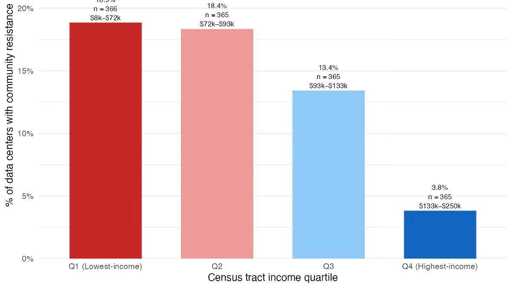
I’m going to go out on a limb here: Nobody is building data centers near wealthy neighborhoods.
Which is why the comparison is based on rate …
Wouldn’t the total number affect accuracy of the rate? I think one chart in the article showed something like 700 proposals for low income areas and 100-200 proposals for high income areas. As N approaches zero, the rate of resistance or cancellation is a lot more sensitive to smaller numbers of events.
Looks like the total n c1,500 was for all known projects in the dataset. The quartiles were determined from within areas with known projects.
So the Q4 range ( $133-250k median household), represents the 25% projects in the richest areas of areas that had projects in them. Hence n is 365/366 “projects” in each each group.
If there are tracts with median hh incomes way above that, but no projects, then “resistance” rate is unknown or even undefined.
Thank you for the explanation.
And if the wealthy need to “resist” a data center, they have the power to do so quietly, successfully, and with little effort. Poor neighborhoods can make all the noise they want, to little or no effect.
Recently proposed data centers that faced pushback were canceled or suspended at more than five times the rate of data centers that didn’t (28.2% vs. 5.2%).
i.e. the data already takes into account that those data centres are more likely to be built in poorer neighbourhoods.
My hypotheses:
- The rich tolerate data centres more because they get more value out of them.
- “AGI soon!” misinformation hits both sides different ways: for one it means “we’re making you richer”, for another it’s “we’re making you obsolete filth”.
No idea if either/both/none is true.
It might also be the kind of data center that is being built. Cheaper data centers are noisier, inefficient with water, etc
Working class areas may already be distrustful towards large companies coming along and using up all of the local resources
The rich are also more educated. Lemmy hates AI, but other upper-middle-class types might just see a datacenter as a big box full of cool technology.
To plumbers and cashiers, it’s more of a new-fangled abomination we don’t need.
Being more educated doesn’t make llms more useful. Being less educated doesn’t make them less fun.
Problem with them is the magnitude of the push vs their usefulness. There was no need for that massive of scaling. It’s all “we must get all the investor money before we have to raise prices to become profitable”.
If there was any education behind making those slopcenters, they wouldn’t make them gas powered in a desert.
No, but appreciating what a big generic building does could require education.
If there was any education behind making those slopcenters, they wouldn’t make them gas powered in a desert.
Yes, they’re designed and built by illiterate cavemen. /s
Like, obviously you know engineers do that, and are educated and well compensated. It seems like you’ve drifted off to a different argument here.
deleted by creator
Also, poor people are likely to already encounter a massive polluter or nuisance being dropped around there for no benefit to them.
Yeah, past experiences with a wonderproject that actually turns out to be meh may very well be part of it. Especially if it’s an older person.
Speaking of pollution, the whole “wifi/5G causes cancer” thing is still out there too, and might be conflated with a datacenter.
Great, they should build them in those neighborhoods.
Even in those neighbourhoods they’re still going to inflate water and electricity prices and consumption.
Not to be a wet blanket, but might that be because data centers are being built in working class neighborhoods at a higher rate than wealthy ones?
Maybe try reading the article before useless speculation on a topic that is clearly outlined in the data provided?
Ok, I’ve read the article and come back. I have the same question. The only statement that tangents my point is this one:
“The lowest-income, least-educated neighborhoods resist most, even among the low-income, low-degree areas facing proposals,” he adds.
But the variable the article cares most about is what happens to data centers that encounter community resistance, vs ones that don’t. Yes they categorize those 2 groups by income level, but there doesn’t seem to be a chart saying “data centers are 5 times more likely to be proposed in low income areas compared to high ones.”
Care to point me in the right direction?
There are nonprofits that help organize to prevent the exploitation/displacement of low income populations while higher income areas are left to self organize. It would also have been useful to track political affiliation of these neighborhoods since it could be a political divide instead. I think people in the the $133k-$250k would be more conservative and thus more pro data center.
As an aside: I wish people would quit using the term ‘working class’ to refer to income level, its such a fuzzy term. Using ‘low income’ and ‘high income’ makes more sense in this case as it better reflects what Geoff Holtzman is talking about and working class could be refering to employment type.
I find this hard to believe. wealthy neighborhoods near me don’t even want warehouses or dense housing.